
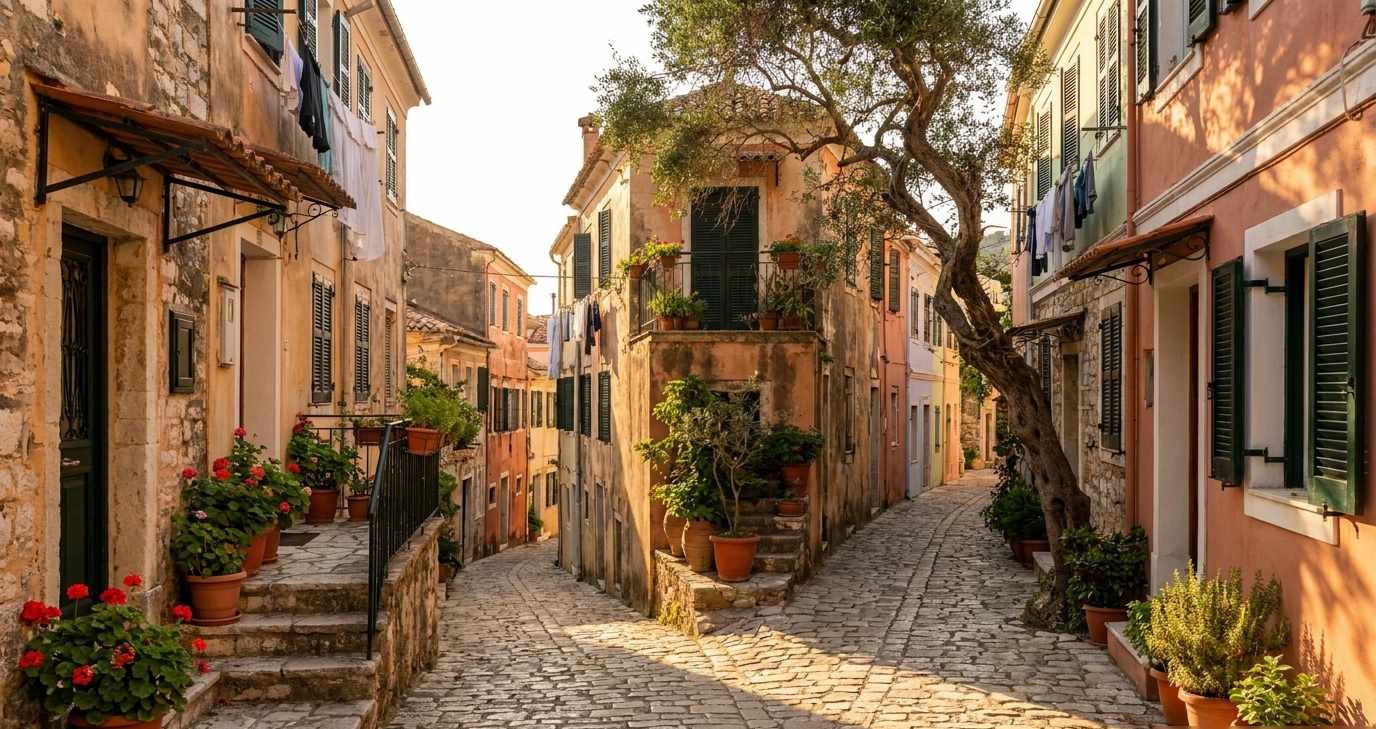
When you first move to Corfu or venture beyond the main roads, one of the first things you notice is that street signs and house numbers simply disappear the moment you turn into a village.
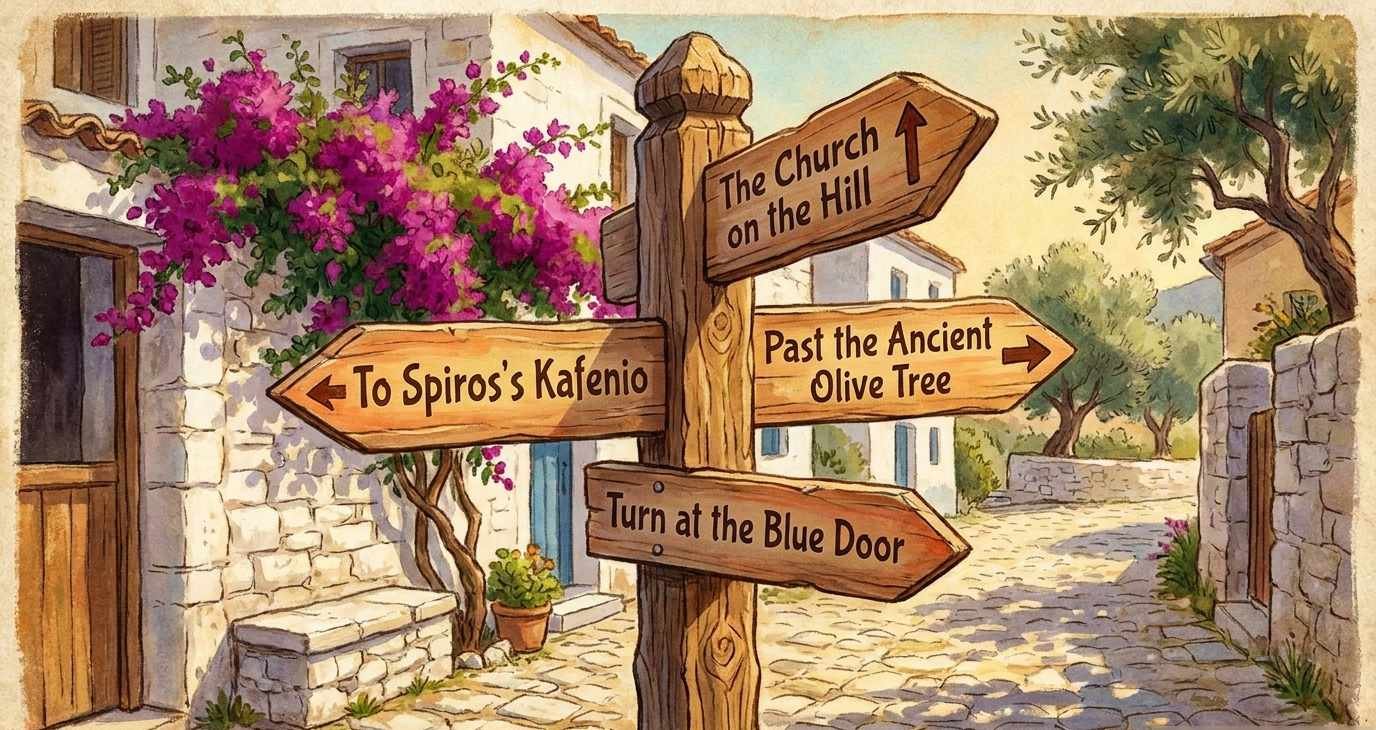
More importantly, if you order a delivery, ask a neighbour where someone lives, or hire a tradesperson to come by, nobody gives you a street address. Instead, you will get directions like: “Take the road up past the old olive press, turn left at the white chapel, and ask for Nikos at the kafenio”.
To anyone not Greek, this is disorienting to say the least. But it seems that, with over 100 rural villages across the island, life here has run smoothly without street names for generations. So here is how the system actually works—and how to find your way around without driving into insanity & frustration.
The Difference Between Corfu Town and the Villages
First, a quick distinction: Corfu Town (Kerkyra) does have formal street names—like Alexandras Avenue or Arseniou—along with numbered buildings. But once you leave the town and head into rural Corfu, street naming was never introduced.
The narrow, stone-paved alleyways that wind through Corfiot villages are known locally as kantounia (derived from the Venetian word canton, meaning street corner – not the Chinese city of Guangzhou). These alleys took shape centuries ago under Venetian rule. Homes were built tightly together along natural hillside contours to maximize space and shelter inside fortified village perimeters. Because villages grew organically around parish churches, family compounds, and communal olive presses, grid layouts were never part of the design and so numbering did not exist.
Homes Are Identified by Families, Not Numbers
Outside of Corfu Town, a house isn’t defined by a number on a door. It’s defined by the family name or a long-standing landmark.
If you ask a resident where a specific house is, they will usually refer to it by:
- Family lineage: “To spiti tou Gianni” (John’s family house).
- Historical function: The old bakery, the village oil mill, or the former schoolhouse.
- Landmarks: Proximity to the village square (plateia), a specific chapel, or a prominent plane tree.
This system relies on shared local memory. It keeps village history alive, even if it leaves first-time visitors scratching their heads. Cute, but totally impracticle for non-local residents (expats) or visitors OR modern merchant sites requiring an address verified by Google.
How Mail and Deliveries Actually Work
A common question from newbies to corfu is: how do you receive mail or parcels without an address?
Official postal addresses in rural Corfu are simple:
- Your Name
- Village Name (e.g., Chlomos, Pelekas, or Kassiopi)
- 5-Digit Postal Code (e.g., 491 00)
For standard post via ELTA (Hellenic Post), delivery works because the rural postman knows almost everyone in their sector personally. If your house is difficult to reach or lacks a mailbox, mail is often left at the central village kafenio (coffee shop) or local store, where residents pick it up during their morning coffee routine.
For private couriers (ACS, SPEEDEX, DHL) or online orders, drivers almost always call your mobile phone when they reach the village square. You simply meet them at the main square or describe your location from there.
Practical Navigation Tips for finding your way when driving on Corfu island
Sat-nav and mapping apps have improved, but they still struggle in rural Greece. GPS algorithms frequently mistake narrow, single-lane pedestrian alleys or unpaved agricultural tracks for main thoroughfares. The main take-away. Trust your eyes, not Google. It is not an excuse to say to your car rental company after you have driven into a stationary house – “sorry but google said it was a road!”
To avoid getting stuck, keep these three rules in mind:
1. Always Orient From the Village Square
Every village has a focal point—usually the main church or central square (plateia). When getting directions, ask for guidance relative to the square rather than trying to follow a digital pin (no kidding).
2. Pay Attention to Physical Landmarks
Locals navigate using visual cues: a bright bougainvillea vine on a corner, red window shutters, a stone archway, or a distinctive olive tree. These are far more reliable than turn-by-turn voice prompts.
3. Don’t Be Afraid to Ask
If you find yourself at a fork in the road and aren’t sure which way to turn, stop at the village kafenio. Asking a local sitting outside is not only the fastest way to get your bearings, but it’s also a big part of everyday village life.
frequently asked questions
What should I put as my shipping address for online shopping?
Use your full name, village name, postal code, and most importantly, your Greek mobile phone number. Courier drivers rely heavily on phone contact to coordinate drop-offs.
How do emergency services find houses in villages?
When calling emergency services, give the village name and a major landmark (such as the school or main church). In urgent situations, it is common practice to send a family member or neighbour to wait at the village entrance to guide the vehicle in.